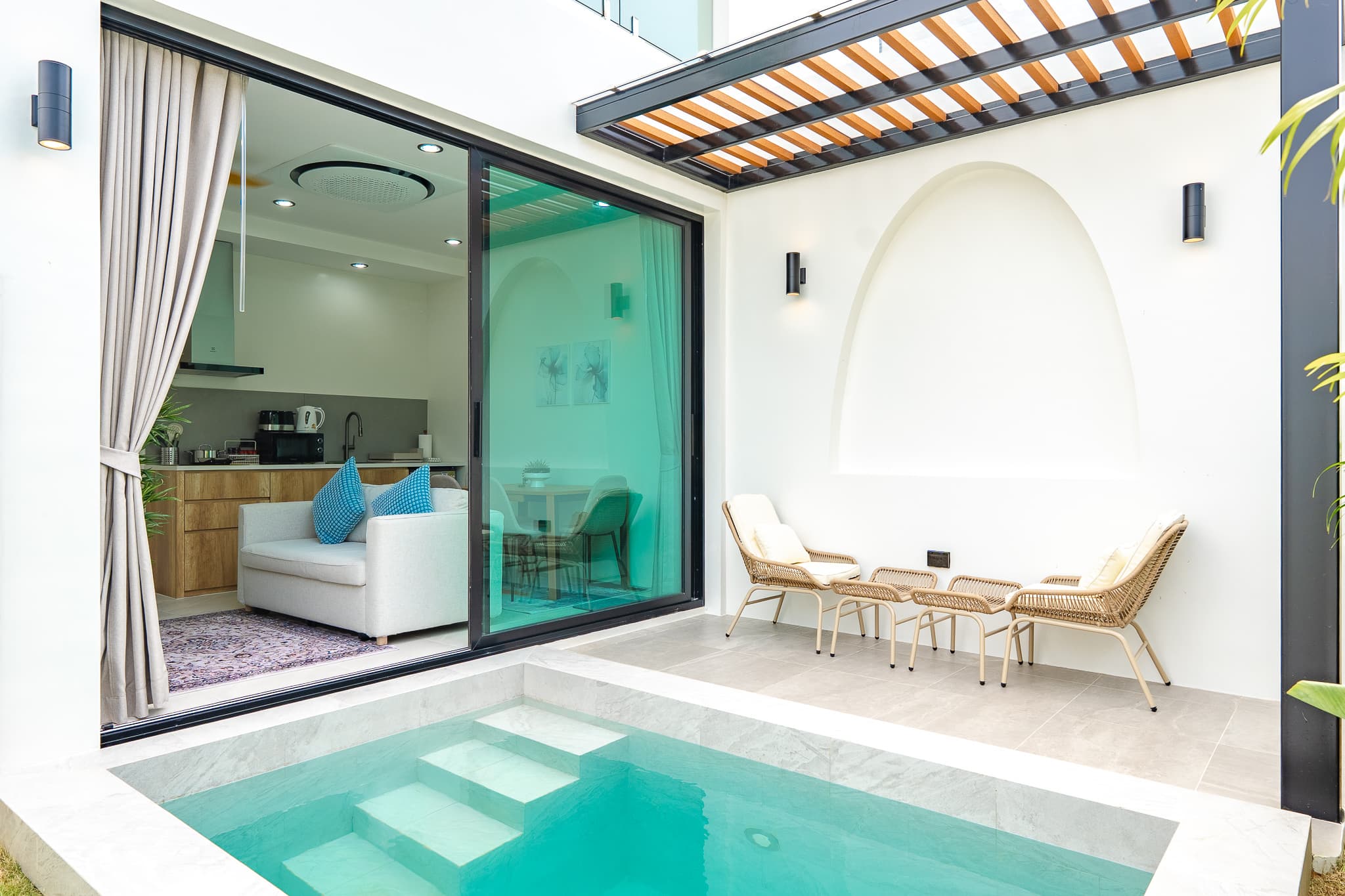
Coastal maintenance
Salt corrosion in a coastal villa in Phuket
Sea air is the quietest recurring cost of owning a villa near the coast in Phuket. Almost nobody raises it before you buy, and almost all of the damage it does is avoidable if you know what it attacks, in what order, and which parts stop being repairable.
How far it reaches
There is no line on the map where salt stops.
The first thing owners want is a distance: a boundary inside which they worry and outside which they do not. We are not going to give you one, because it does not exist and anyone who quotes you a figure in metres is guessing. What we can tell you is how the load varies, and why two houses on the same street are not in the same situation.
It arrives as spray, then it stays as a film
Wind lifts salt off breaking surf and carries it inland as an aerosol so fine you never see it land. It settles on every outdoor surface as an invisible film. Sea salt is not merely hygroscopic, it is deliquescent: above roughly three quarters relative humidity it pulls water back out of the air and turns liquid, and the magnesium chloride that comes with sea spray stays damp well below that. Phuket sits above that line on most days of the year, day and night, which is why the film on your hardware is essentially never dry.
Two mechanisms, and everything here is one of them
A damp salt film on metal does two separate things, and knowing which one you are looking at tells you what to do about it. First, chloride attacks the thin passive oxide layer that protects a single metal on its own, breaking through it in small localised spots that cannot reform: that is pitting in stainless steel, and chalky white powdering in aluminium, and it needs no second metal to happen. Second, where two different metals touch, the damp film turns the pair into a small battery and the less noble of the two is quietly consumed to protect the other: aluminium fin against copper tube in a condenser, a steel screw in an aluminium frame. Those are the two mechanisms. Everything on this page is one or the other, and neither of them stops on its own.
Distance helps, exposure decides
The load does drop as you move inland, sharply at first. But a villa set high on a slope with an open view of the sea catches wind that a house nearer the water, tucked behind a ridge and a stand of trees, never sees. Orientation matters as much as distance: the seaward face of a house corrodes visibly faster than the sheltered face of the same house. If you want to know your own exposure, look at your neighbours’ gate hardware and outdoor light fittings rather than at a map.
The monsoon concentrates it
From roughly May to October the south west monsoon pushes wind onshore along the west coast for months at a time, and rough water throws far more spray into the air than flat water does. Owners assume the rain washes it off, and sometimes it does. Wind driven rain, however, arrives loaded with salt and pushes it into places plain spray never reaches: into track channels, behind fascia boards, into the gap between a frame and its sealant. A house can come out of the wet season saltier than it went in.
The east side is different, not exempt
From May to October the eastern side of the island sits in the lee, sheltered water produces very little breaking surf, and there is correspondingly little airborne salt. From November to February the north east monsoon turns the wind onshore over there too, but the fetch across Phang Nga Bay is short, so you get the wind without the surf. What the east side does have, in every season, is air that moves less and surfaces that stay wet longer after rain. So the profile changes rather than disappears: less chloride, more sustained damp, more mould and staining on the same fittings. It also has an aggressor of its own that nobody writes about. Mudflats and mangrove give off hydrogen sulphide at low tide, which blackens copper and silver and goes after electrical contacts, switch and socket terminals, and the silvered contacts inside outdoor fittings and pool control gear. Owners smell it and file it under tides rather than under maintenance. We work across the whole of Phuket, and the schedule genuinely is not the same on the two coasts.
Your own pool contributes, and so does the room behind it
A salt chlorinated pool runs at a small fraction of the salinity of sea water, and a still pool with no water feature throws very little of it into the air. The transfer is more ordinary than the aerosol story suggests: splashing, wet feet, wet swimwear over a rail, and water evaporating on the coping and the surround and leaving its salt behind. That is enough to reach the pool ladder, the balustrade around the terrace, the outdoor shower, the furniture frames and the fixings holding the sun loungers together. There is a second cause that owners inland almost never look at, and it is often the larger one: the plant room. Acid and chlorine stored in an unventilated space give off fumes that corrode everything shut in there with them, including the pump housing, the control box and the enclosures of the equipment they are meant to serve. None of this is an argument against a salt pool. It is an argument for ventilating the plant room, for keeping the chemicals somewhere other than on top of the electrics, and for not putting cheap metal near the water.
What goes first
The order in which things actually fail.
Roughly this order, on the houses we look after and the ones we are asked to inspect for owners thinking of switching. None of it is dramatic. It is a slow erosion that becomes visible only when something stops working, usually with guests in the house.
The outdoor air conditioning units
This is almost always the first real failure. The condenser coil is aluminium fin bonded to copper tube, two different metals in permanent contact, which is precisely the arrangement salt air exploits. The fins powder away and the unit loses its ability to shed heat, so the compressor works harder and hotter for the same room temperature, then fails in the month you least want it to. The casing rusts from the base plate upward, and the mounting bracket, which is usually painted carbon steel, rusts from behind where nobody looks.
Coil protection has three levels, and only two of them are real
This is decided the day the unit is bought, so it belongs here rather than in a maintenance list. The blue or gold factory fin coating that comes on most mid range machines sold in Thailand is standard, thin, and worth very little in salt aerosol: it is not a coastal specification and it should not be sold to you as one. A manufacturer seaside or anti corrosion model is a genuine step up with a genuine price attached, and it is the right call anywhere in the front row. An applied coil coating, put on by the installer before the unit goes into service, is the third route, and the important thing about it is timing: it costs far less on a new coil than on one already going, and it does nothing at all once the fins have started to break down. Coat it on the day it is fitted or do not bother.
Hinges, handles, locks and the rest of the ironmongery
The first thing you actually see. Doors start to sag, locks bind, a handle leaves an orange smear down a white wall, and a bathroom door that faces the terrace no longer closes properly. Plated brass and unmarked hardware sold as stainless can go in a single season this close to the water. Guests notice a door that will not lock long before an owner abroad hears about it, and they mention it in reviews, which is how a hinge becomes a commercial problem rather than a maintenance one.
Sliding door tracks and rollers
The most expensive item on the list and the one owners understand last. Salt combines with sand and grit in the bottom track to make an abrasive paste. Roller bearings stiffen, then seize, and once a roller stops turning the door is being dragged rather than rolled, so the wheel ploughs a groove along the track. Up to the moment the roller seizes, this is a small job. After it, the price of the answer depends entirely on how soon you look, and there is a whole section below explaining why.
Outdoor light fittings
The housing corrodes first and looks shabby, which is the least of it. What matters is inside: the terminal screws, the gland where the cable enters and the earth connection. Salt and moisture get past a degraded seal, the terminals corrode, and the fitting either stops working or becomes an electrical fault around a pool terrace. Cheap fittings on a coastal house are a recurring purchase, and treating them as a safety item rather than a decorative one changes how often you inspect them.
What goes next
Slower, and more expensive when it arrives.
Balustrades, handrails and glass clamps
Stainless posts and rails around a terrace or pool start with brown discolouration, which is cosmetic, and owners are usually told correctly that it is nothing. The item to watch is not the post but the clamp or spigot holding a glass panel, because that fitting is structural and it is often the cheapest part of the assembly. Inspect the fixings and the base plates where they meet the floor, which is where water sits. A stained handrail is a cleaning job. A pitted glass clamp on a first floor terrace is not something to think about twice.
Outdoor taps, showers and pool equipment
Chrome plating is a barrier, and a barrier only works until it opens. Once a blister appears the base metal underneath corrodes quickly and invisibly, so a tap that looks merely tired seizes solid the following season. Outdoor shower valves are the usual casualty, followed by garden taps that will no longer shut off fully. Pool pump housings, heat pump casings and chlorinator cells all sit outdoors in the same air, and their electrical enclosures deserve the same annual look as the light fittings.
Screws, bolts and everything holding something else up
The failures nobody sees coming are the mixed metal ones: a carbon steel screw in an aluminium frame, an unknown grade bolt in a stainless bracket, a fixing chosen by whoever was on site that day. This is the galvanic half of the mechanism, and it works inside the joint where you cannot see it: the less noble metal corrodes preferentially, quietly, from the inside out. The assembly looks perfect until the moment it does not hold. When something is replaced on a coastal house, the fixings should be replaced with it, in a grade you have actually specified.
Reinforcement inside the concrete
The slowest problem and the only one that is genuinely structural. Chlorides work through the concrete cover and reach the steel, the steel rusts, and rust occupies more volume than the metal it replaced, so it pushes the concrete off from the inside. The signs are a rust coloured weep on a soffit, a hairline crack running in a straight line that follows a bar, and a patch that sounds hollow when tapped. Thin cover, poorly compacted concrete and a seafront position are the combination that produces it. Painting over a rust stain hides it for one season and costs you the repair twice.
304, 316 and 201
Three grades, and the entire difference near the coast.
They are all sold as stainless steel. They all look identical on a showroom stand. On a house in the front row they behave nothing alike, and the specification is decided at build or renovation, by somebody who may never have to maintain the result.
What the numbers actually mean
Both 304 and 316 are chromium nickel stainless, and both rely on a thin passive oxide layer that reforms itself when scratched. 316 contains molybdenum, which 304 does not, and molybdenum is specifically what resists attack by chlorides. Chlorides are exactly what sea air delivers, every day, in a fine damp film. That is the whole of the difference: 304 is a perfectly good steel inland and the wrong steel in salt aerosol.
What 304 does when it starts to go
It begins with tea staining, a brown discolouration that wipes off and comes back. At that stage it genuinely is cosmetic, which is why owners are reassured and stop looking. Underneath the stain, pitting can start: small, deep, localised holes where the passive layer broke down and could not reform. Pitting does not polish out, and it removes material where it matters, so a fitting that looks tired on the surface can have lost real section inside. That is the point at which cleaning stops being an option.
Where 316 is worth the difference
Anything structural, anything exposed, and anything that is disruptive to replace: balustrade posts, glass clamps and spigots, pool ladders and handrails, gate hardware, exterior anchors and any fixing that holds weight above people. The price gap at purchase is modest against the cost of buying the same item twice, and the second purchase includes labour, access and a house out of use while it happens. This is one of the few decisions in villa maintenance where paying more at the start is simply cheaper.
Even 316 is not maintenance free
It is marketed as marine grade, and owners hear that as permanent. It is not. 316 in an unrinsed coastal position will still tea stain, and in a crevice where salt concentrates and oxygen cannot reach, it can still pit. The passive layer needs a clean surface and air to keep repairing itself, which is what rinsing provides. Better metal buys you a wider margin for error, not an exemption from the routine.
The third grade, the one nobody quotes you
A great deal of what is sold in this market simply as stainless is grade 201: an austenitic steel where much of the nickel has been replaced with manganese to bring the price down. It stains within a season near the water and pits after that, and it turns up most often in the imported unbranded fittings that get used for railings, brackets and furniture. The trap is that a magnet will not find it. 201 is austenitic like 304 and 316, so the magnet test that owners are told to do tells you almost nothing, and worked 304 can be slightly magnetic anyway. If somebody demonstrates a magnet at you as proof of quality, that is the moment to ask for paperwork instead.
How to find out what you actually have
Ask the fabricator or the builder for the grade in writing, and for anything structural ask for the material certificate rather than a verbal answer. A grade stamp helps, but know where to expect one: it is common on tube and rolled profile and rare on finished parts, so the clamps, the spigots and the cast base plates, which are the pieces that actually matter, usually carry no marking at all. That is precisely why the certificate is the request to make for anything holding weight. Where nobody can tell you what a fitting is, assume the weaker answer and inspect on that basis.
Fresh water
Rinsing, and how often it really has to happen.
Rinsing costs less than any other task on a coastal villa and prevents more than any of them, which is why it is also the first one that quietly stops happening when nobody is checking. It is the difference between hardware that lasts years and hardware that lasts seasons. It is also worth knowing what is actually coming out of the hose before you start.
What a rinse is actually for
It is not cleaning for appearance. It is removing the salt film before it has time to sit damp against metal and do its work. Plain fresh water does most of it, and no chemical is needed on the majority of surfaces. What matters is that corrosion does not run backwards and rinsing builds no credit. Nothing you did last year protects the metal this month. Three unrinsed months through the monsoon do their own damage, on their own account, and none of it comes back off afterwards. That is why the schedule matters more than the technique.
Know what your hose is running on
A page about salt that never asks where your water comes from has skipped the first question a plumber here would ask. A great deal of Phuket runs on borehole water rather than mains: it is hard, frequently heavy in iron, and along the coastal strip it can take in salt of its own late in the dry season when the water table drops and sea water moves in behind it. Rinsing stainless with that leaves scale and rust coloured runs down the metal you were trying to protect, and at worst it lays fresh chloride onto hardware you have just cleaned. On mains supply, rinse away. On a borehole, have the water tested, and where it comes back hard or brackish use mains or filtered water for the hardware and wipe it dry behind you rather than letting it evaporate in place. It is the cheapest test on this page and almost nobody does it.
A realistic frequency, not an aspirational one
On a house in the front row with an open aspect to the sea, hardware, tracks and outdoor unit casings want a rinse weekly. A few streets back and sheltered, every two weeks to monthly holds up well. After any prolonged onshore blow or a storm that has clearly carried spray, rinse regardless of where you are in the schedule, because that single event deposits more than several ordinary weeks. Anyone who tells you a coastal house needs this twice a year has not maintained one.
The condenser units need a specific method
Switch the unit off at the isolator before anything else. Then use low pressure water through the fins, following the direction the fins run, and never a pressure washer: high pressure folds the fins flat and permanently reduces the capacity of a unit you were trying to protect. Where the coil is greasy rather than salty, a proper coil cleaner and a rinse is the job, and it belongs to a technician rather than to a garden hose. Let it dry before switching back on.
The places the rinse never reaches
The top track of a sliding door as well as the bottom one. The underside of balustrade base plates. The back of a condenser unit standing close to a wall. The inside of light fittings and the gate motor housing. These are precisely the positions that fail first, because they are sheltered from rain but not from airborne salt, so they accumulate and never wash. A routine that covers only what is visible from the terrace is not a routine.
It only counts if somebody verifies it
This is where overseas owners lose the game. The schedule exists, the person is paid, and no one ever confirms it happened. We photograph the work, date it, and put it in the report you receive, so the record exists whether or not you ever ask for it. Ask any manager, including us, to show you that record for a property they currently look after. A company that cannot produce one has told you what the schedule is worth.

Once a year
What has to be treated whether or not anything looks wrong.
Preventive work on a coastal house is unsatisfying by design: done properly, nothing happens, and it feels like money spent on a problem you never had. That is what it is for. One thing to be clear about before the list: annual here means the deep version of jobs that also happen more often, not the only time they happen.
Air conditioning: the deep service, on top of the routine one
Start with what the annual service is not. In this climate a split unit wants cleaning every three to four months, and an outdoor unit near the water wants rinsing on the same rhythm as the rest of the hardware. The annual visit sits on top of that, not instead of it, and a technician who only comes once a year is not maintaining a tropical villa. What the deep service adds: a chemical clean of the coil rather than a wash, the flare connections and service valves checked, the fixing brackets inspected from behind, and the insulation on the refrigerant line looked at along its whole length rather than at the ends. That foam splits under UV and heat, not salt, and once it is open it holds water against the copper instead of keeping it dry, which gives you corrosion along the line rather than at one joint, and condensation running back into the ceiling. A heavy unit sitting on a rusting bracket above a terrace is a safety matter and not a comfort one. On the units closest to the sea, price an applied coil coating at this visit while the coil is still sound. And ask the technician which units he thinks will not see another two seasons, then believe him.
Ironmongery, stripped and lubricated
Hinges, locks, latches, gate hardware and window stays, cleaned back and lubricated with a marine grade product rather than a general purpose water displacing spray that flashes off in a fortnight. Replace corroded pins and screws as they turn up, one at a time, in a grade you specified. Doing this annually costs a morning of labour. Not doing it means replacing whole handle sets and, eventually, doors that have been hanging out of true for two years.
Tracks, rollers and drainage
Every sliding assembly cleaned out completely, top and bottom, with the grit removed rather than pushed along. Check that the weep holes in the bottom track are clear, because a track holding standing salt water is a track being destroyed at maximum speed. Inspect the rollers for stiffness and replace them on condition rather than on failure. Run a fingertip along the running surface while you are down there: a groove you can feel is the moment to read the section below, not next year.
Sealant, coatings and timber
Walk every window and door frame and check the sealant beads, because that bead is the only thing keeping salt water out of the frame cavity and out of the fixings inside it. Touch in any bare metal or chipped coating before rust starts rather than after. Timber then divides in two, and getting the division right matters more than the product. Teak, which is most of the exterior timber on this island, is protected by its own oils: let it silver if you like the look, wash it gently once a year, and do not oil it outdoors, because in this heat and humidity a film traps moisture, feeds mildew and black spotting, and goes sticky. What you watch on teak is the end grain and the fixings, not the colour. Non durable timber and anything already stained or coated is the opposite case entirely: treat it before the rains rather than during them, because a wet substrate will not take what you put on it.
Concrete, structure and electrical safety
Walk the underside of terraces, balconies and roof overhangs once a year with a torch, looking for rust weeping and for cracks that run in straight lines. Deal with them while they are stains, because the same defect two years later is a repair involving cutting back concrete, treating steel and rebuilding the surface. At the same visit, put an electrician on the pool and the outdoor circuits, and be specific about what you are asking for. Press the test button on the residual current device covering those circuits and have the trip time measured rather than assumed, because plenty of older villas here have either no device at all or one that has not tripped in years. Then have the equipotential bonding checked on the pool structure, the ladder, the handrail and the underwater lights, which the Thai installation standard requires and which is routinely missing. Salt air degrades earth connections quietly and gives no warning. This is the last of the three failures on this page that hurt a person rather than a budget: the other two are the glass clamp on a first floor terrace and the condenser bracket over a walkway.
Clean it or replace it
The signs that say a part is finished.
Most maintenance disputes on a coastal villa are really this question. Here is how we decide, and how you can decide without us.
Staining wipes off, pitting does not
Brown discolouration that comes away on a cloth and leaves sound metal underneath is tea staining, and it is a cleaning job however unattractive it looks. Small rough craters that you can feel with a fingernail, and that stay when the stain is removed, are pits. Pitting means material has gone from inside the section, not from the surface, and no amount of polishing restores it. On anything decorative you can live with pits; on anything that carries load you cannot.
Rust bleeding through a painted surface
When rust appears through a coating, the corrosion is already established behind it and the coating is now trapping moisture against the metal. Repainting over it is not a repair, it is a delay, and it usually buys one season. The real answer is to take the coating back to sound metal, treat, and recoat, or to replace the item where taking it back is not practical. Brackets, railings and gates are where this shows up most.
Play, noise and effort
A hinge that has developed movement it did not have, a roller that clunks, a handle that wobbles, a sliding door that now needs two hands. All of those mean metal has been lost from a bearing surface. Wear accelerates once play appears, because the loading is no longer where the part was designed to take it. This is the stage at which a cheap replacement is still a cheap replacement.
A unit that runs but no longer cools, and why that is two faults
These get folded together and they are not the same thing. A condenser that has lost its fins still starts and still makes noise, but it cannot reject heat: the discharge pressure climbs, the unit runs and runs without ever cycling off, the electricity bill goes up before anything else does, and the room will not hold through a hot afternoon. Repeated refrigerant top ups are a different fault altogether: that is a leak, and on the coast it is usually the flare connections, the service valves, or copper corroding under insulation that has split. A technician who simply adds gas on each visit is treating a symptom in the first case and overcharging a machine that did not need it in the second. Both roads end at replacement, for different reasons. Add up two or three call outs, the electricity a failing unit burns, and one guest complaint about a bedroom that will not cool, and replacement is the cheaper of the two paths. Do it in the quiet months rather than in the season.
Anything whose failure has a consequence
A glass clamp on a raised terrace, a balustrade fixing, a light fitting above water, a bracket over a walkway where people pass. For these there is no cleaning conversation and no waiting until next year. If the fixing shows pitting or the fastenings show serious loss, it is replaced, in the right grade, now. This is the one category where we do not ask an owner to weigh the cost.
The hidden cost
A sliding door with a dead track stops being a maintenance item.
This is the item that catches owners out, and it is the reason this page exists at all. Everything else on a coastal house degrades in a way you can chase with maintenance. This one has a point on the curve where the cheap answers run out, and almost the whole cost of the problem is decided by which side of that point you find it on.
A track is not a spare part
On most Phuket villas the glazing is a bespoke aluminium system, made to the size of the opening, frequently by a fabricator who has since changed profile ranges or stopped trading. The bottom track is normally part of the frame, set into the floor structure and sealed into the finish, so it is not a component you unbolt and swap the way you swap a roller. Once the running surface is gouged, new rollers simply wear out again in the same damaged groove, which is why owners who have just paid for rollers are back within the year. That is where the escalation starts, and there is one step in between before the expensive end of it.
The step in between, and the reason to look early
A scored track can usually be capped. A stainless steel track cover, bedded and fixed into the damaged channel, gives the rollers a sound surface to run on again. It is an off the shelf product that any aluminium fabricator here will know, it is roughly a day of work, the panels stay in, nothing is broken out of the floor, and it can be done between guests without anyone noticing. Take that as the reason to look at your tracks early, not as permission to leave them. A cap needs a track that still has a shape to hold it. Once the profile is deformed rather than scored, once the drainage through the track is destroyed, or once there is not enough sound metal left to fix into, capping stops being an option and you are into the frame.
What replacement actually involves
The glass panels come out, the frame is cut out, the floor finish around the threshold is broken out, a new frame is set and sealed, the floor is made good, and the panels go back or are remade. If the terrace is natural stone or timber, matching what is already there becomes a separate problem with its own lead time. This is days of work with cutting, dust and open glazing, in a house that cannot receive guests while it is happening. The invoice is the smaller half of the story.
The real cost is the calendar
A door discovered in December is a job that has to happen in the months you least want work going on in the house, or a job you defer while a heavy glass panel keeps running on a damaged track. The work cannot sensibly be rushed, and a house with its glazing out cannot receive anyone at all. That is why we raise track condition in April and not in January, and why owners sometimes find our low season reports tedious. A track capped in the quiet months is an afternoon nobody remembers afterwards. The same track found a year later, in the wrong month, is the job described in the card above.
Rollers are the cheap end of the same problem
Cleaning the track, keeping the drain holes clear and replacing rollers before they seize is inexpensive, quick, and can be done between guests without anyone noticing. Nothing else on a coastal villa has this ratio between the cost of prevention and the cost of the alternative. If you take one thing from this page, take this one, and go and slide every door in your house.
Before you buy
What to look at on a coastal villa, before the transfer.
Buyers inspect the view, the pool and the kitchen. On a house near the sea the condition that decides your first three years of spending is in the hardware, and it takes about twenty minutes to assess.
Slide every door yourself
Do not let anyone open them for you. Take every sliding panel in the house, particularly the ones facing the sea, and move it from end to end. Listen for grinding, feel for a point where the effort changes, and look into the bottom track for a groove or for standing water. A house that has been maintained tells you so in ten seconds through the door handles.
Ask the grade of the metal, in writing
For the balustrades, the glass clamps, the pool fittings and the exterior anchors. Ask who fabricated them and whether that fabricator is still trading, because you will need them for anything that has to be matched later. A seller who has the answer has probably looked after the rest of the house too. A shrug is itself information, and it should move your number.
Look underneath and behind
Take a torch to the soffits, the underside of the terrace and the balcony edges, looking for rust weeping and for hairline cracks running in lines. Then look at each outdoor condenser: the state of the fins, the bracket behind it, and whether the insulation on the refrigerant line has gone brittle. Ask how old the units are, because on a resale they are almost always the original ones and they are the first thing you will be replacing.
Ask what routine the house has been on, and what the water is
An empty villa that sat unrinsed for two years while it was on the market is a completely different purchase from one that was managed continuously, even if they look identical on the day you visit. Ask for maintenance records, service history on the air conditioning and any pool equipment invoices. Ask separately whether the house is on mains water or a borehole, and if it is a borehole, whether anybody has ever had it tested. If there are no records at all, assume the routine was not happening and price the catch up work into your offer rather than into your first year of surprise.
Build the first year budget yourself, before you sign
Nobody can give you a figure for a house they have not walked, and anyone who offers one is guessing. What you can do is count, and the counting is specific to your house rather than to the market. Count the outdoor condensers and get the age of each one. Count the sliding panels, and the separate sets of hardware they run on. Count the exterior light fittings, including the garden and the pool surround, which is where people always undercount. Count the balustrade fixings, the glass clamps and the spigots. Take those four counts to a contractor and have them priced while you can still move your offer, rather than after the transfer. What comes back is a first year budget built out of your own house. None of that is a reason to avoid buying near the sea. It is a reason to know what you are buying, so that the work is a plan rather than an emergency in your first high season. We will walk a property with you before you commit, and tell you what we see.
Straight answers
What owners ask us about salt damage.
- What villa maintenance and housekeeping actually involves
- How to choose a property management company in Phuket
How far from the sea do I have to be before this stops being a problem?
Is 316 stainless really worth the extra cost?
Can I just rinse everything with the garden hose?
My stainless balustrade has brown marks. Is it failing?
Does a salt water pool make the corrosion worse?
Should I oil the teak on my terrace before the rains?
Do you handle this on the properties you manage?
Reviewed . We update these pages when the practice on the ground changes, not on a schedule.
Where to go next
Our services
- Villa management in Phuket
- Condo management in Phuket
- Airbnb management in Phuket
- All property management services
- Villa care for absentee owners in Phuket
- Rent out my villa in Phuket
- A second opinion on how your villa is being managed
- Villa maintenance and housekeeping in Phuket
- Home property management in Phuket
- About Phuket Property Manager
- Contact a property management company in Phuket
Guides for owners
- Employing villa staff in Phuket
- Off-plan villa handover in Phuket: the snagging inspection
- How to choose a property management company in Phuket
- Self-managing versus hiring a property manager in Phuket
- Short-term rental rules in Phuket: the 30-day question
- Your rental guarantee is ending. What now?
- Switching property manager in Phuket
- Property management fees in Phuket
- The true cost of running a villa in Phuket
- Property management in Phuket for foreign owners
- Mould and humidity in an empty villa in Phuket
- Water in a Phuket villa: the tank, the pump and the day it runs dry
- Villa air conditioning in Phuket: servicing, faults and who pays
- Villa pool maintenance in the Phuket rainy season
Talk to the person who would look after your property.
No call centre, no sales team. We keep the portfolio small on purpose.